Solutions / Tympanometers / How to Identify an Ossicular Discontinuity
How to Identify an Ossicular Discontinuity
How to Identify an Ossicular Discontinuity
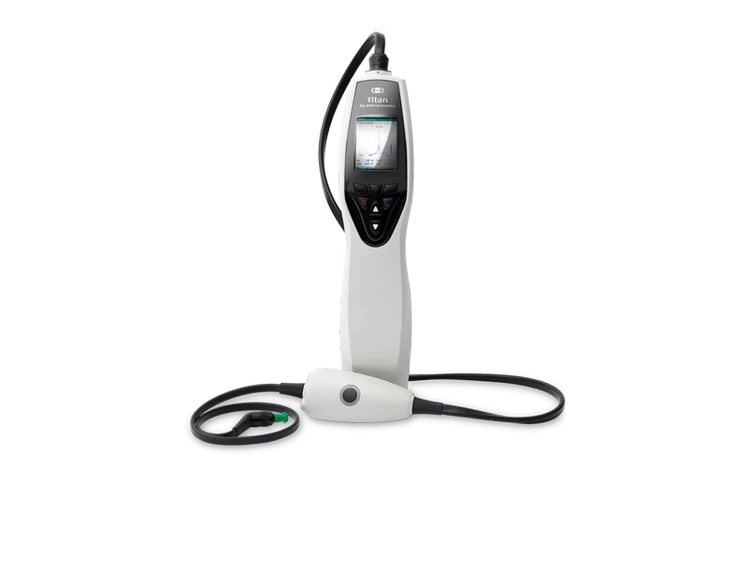
Learn how to identify an ossicular chain discontinuity with the Titan tympanometer.
Titan Support
The information presented here is based on clinical examples as well as modeled patterns. Text and accompanying. Absorbance sketch is authored by Navid Shahnaz, PhD, Aud, Associate Professor of Audiology in the School of Audiology & Speech Sciences at the University of British Columbia (UBC).
Unless the Absorbance is evaluated at tympanometric peak pressure, any positive or negative middle ear pressure will influence the absorbance characteristics and obscure a direct interpretation.It should be noted, that recordings on ears with negative middle ear pressure will vary between patients – the shown Absorbance pattern is a sketched example only.
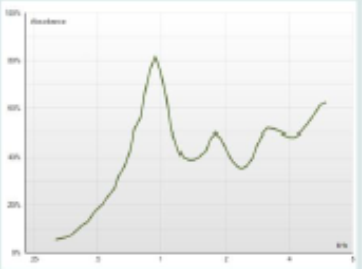
The Absorbance exhibits a very pronounced peak somewhere in the range slightly below 1 kHz. Absorbance in general increases in the frequency range below 900 Hz and decreases in the frequency range between 2.5 kHz and 3.5 kHz.
All Absorbance measures need to have a good probe fit to be reliable. Evaluating Absorbance as provided by the 3D Tympanometry test ensures that a reasonably air tight probe seal was accomplished, as the air pressure sweep would not have been performed otherwise. In addition to an air tight probe seal, a deeper rather than a shallower probe insertion ensures the most accurate Absorbance measures. Shallow insertions tend to provide more elevated Absorbance readings at lower frequencies. This is somewhat similar to normal Tympanometry measures that are also influenced by probe fit and probe insertion depth.
Effects of Middle-Ear Disorders on Power Reflectance Measured in Cadaveric Ear Canals, Voss, Susan E., Merchant, Gabrielle R.,Horton, Nicholas J., Ear & Hearing. 33(2):195-208, March/April 2012.
Acoustic Immittance Measures, Basic and Advanced Practice, 2013, Lisa Hunter, Phd, FAAA, Navid Shahnaz, PhD, Aud. (C), Plural Publishing. ISBN10: 1-59756-437-0, ISBN13: 978-1-59756-437-3.
Contact your local distributor
Our world-wide experts are ready to help you find the right solution.