Titan Support
Electrical Evoked Stapedial Reflex Thresholds (eSRT) can be a very useful objective measure for the upper stimulus levels during the programming of a cochlear implant (Brickley et al., 2005; Buckler et al., 2003). The measure is particularly useful during the fitting of cochlear implants in pediatrics (Cowdrey & Dawson, 2003), but also during the fitting on adults in particular adults unable to provide reliable behavioral measures (Andrade KC et al., 2013, Wolfe & Kasulis, 2008).
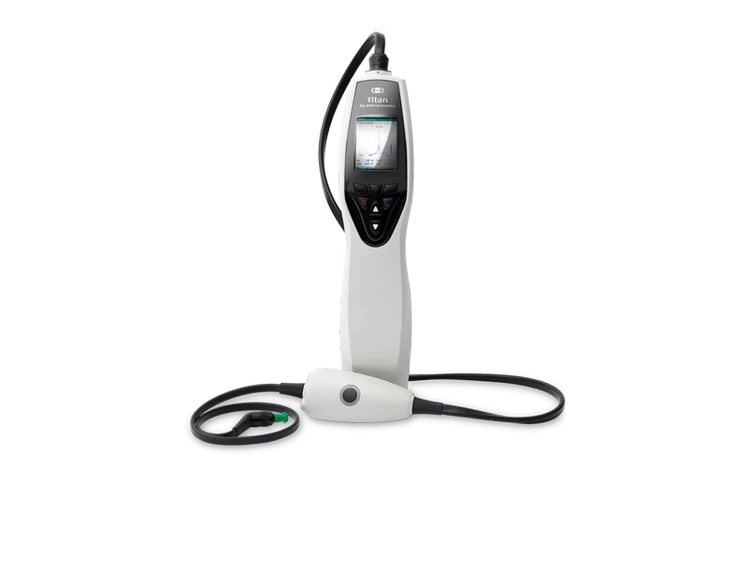
A PC controlled Titan with an eSRT license
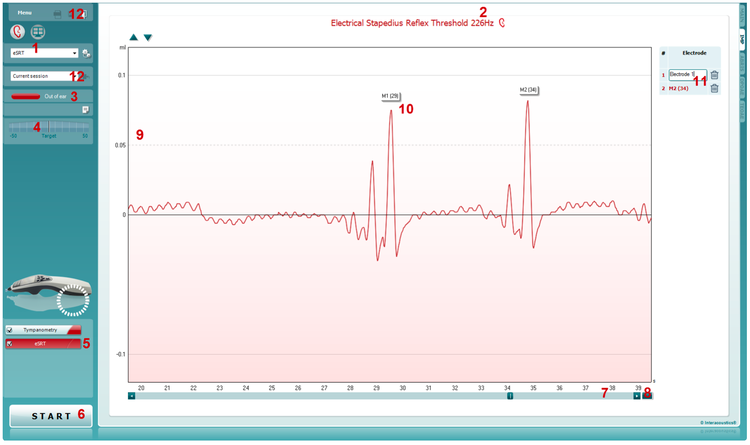
When using the Titan to obtain the eSRT levels, the cochlear implant is used as the stimulus source, while the Titan is used for monitoring. Titan monitors if there is any change as a function of time when a stimulus is presented through the cochlear implant.
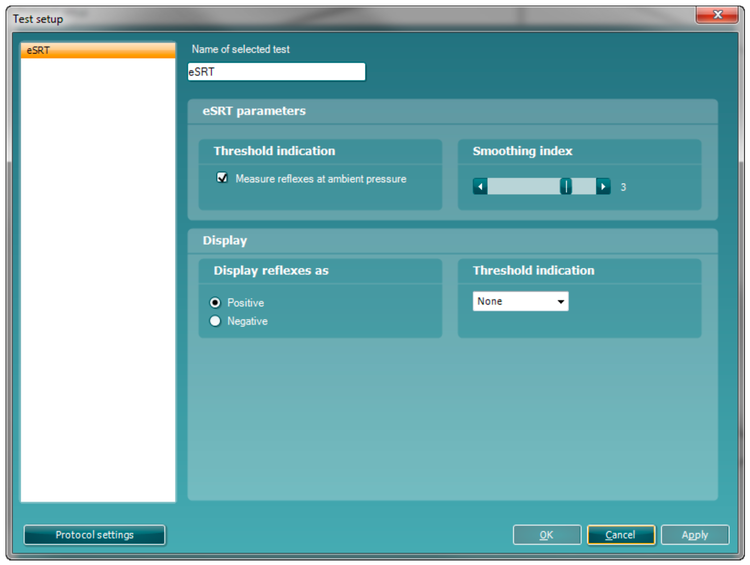
Enter Menu – Seup – Protocol Setup and create a protocol pressing New. Add the eSRT test as a protocol by selecting and pressing Add. Press Settings to modify the protocol created.
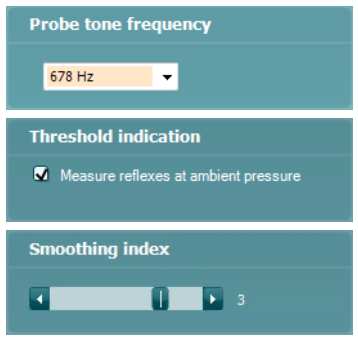
Set the probe tone frequency to 226 Hz, 678 Hz, 800 Hz, 1000 Hz.
Check the box to obtain an eSRT at the ambient pressure. If unchecked, the pressure will be obtained at peak pressure, if a peak pressure is present.
The more smoothing that is applied, the less noisy/detailed the trace will be. The smoothing level can be set from 0-4, with 0 being no smoothing applied and 4 being maximum smoothing applied.
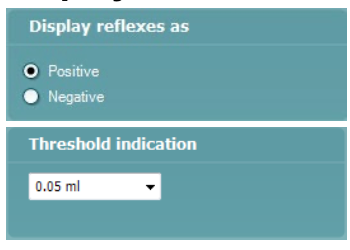
Set the display of the reflexes to positive to have a positive deflection and negative to have a negative deflection of the reflexes.