Solutions / Tympanometers / Best Practices for OAE Testing
Best Practices for OAE Testing
Best Practices for OAE Testing
Learn how to get the most out of your Titan for OAE testing.
Titan Support
There are a number of things to consider when conducting OAE testing in order to ensure valid and reliable results. Consideration of the factors below will ensure an optimal OAE test.
Ensure that the protocol that you select or create is valid for the test population and for the expected clinical outcome. Protocols generally differ between those used for Newborn Hearing Screening where a clinical outcome is based on a single test versus those used in a diagnostic follow up situation where the OAE result forms part of an overall test battery approach where many tests are analyzed to form a conclusion.
Refer to the Titan Additional Information manual for more details about test parameter considerations when creating an OAE protocol. This document also highlights parameters to consider when creating a screening TEOAE protocol: Neonatal Hearing Screening and Assessment (2002). Transient Evoked Oto-Acoustic Emission (TEOAE) Testing in Babies.
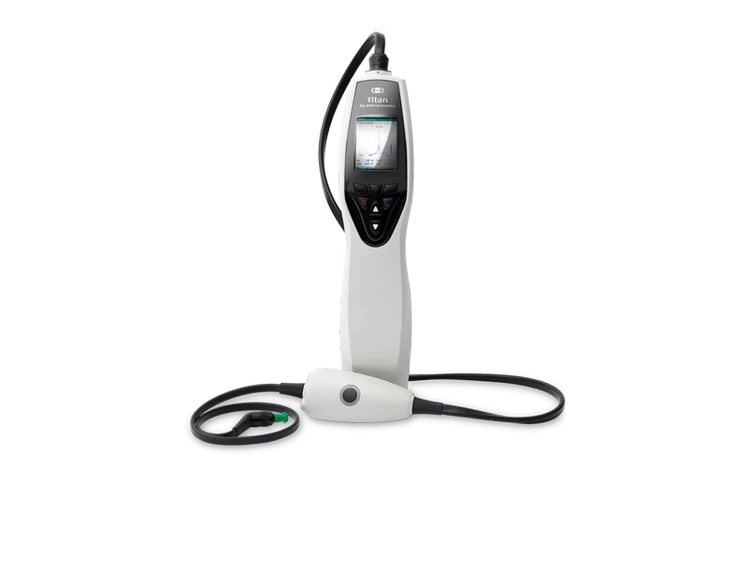
When performing OAE testing with Titan, it is important to use either the Long Clinical Extension cable with the shoulder box or the Preamplifier cable. As described in the manual, testing must not be conducted while the probe is directly connected to the Titan or directly connected to the Preamplifier cable. OAE tests should not be performed while holding the probe in the patient’s ear as this increase noise levels and the chance of incorrect delivery of the stimulus.
Probe performance is crucial to OAE test results. It is common practice to conduct a probe test at the beginning of each day before starting to test on patients to ensure that the probe is functioning correctly.
Before conducting the probe test, ensure that the probe tip is clean and free of wax and/or debris
Before conducting the probe test, ensure that the probe tip is clean and free of wax and/or debris
Always conduct the probe test in a quiet test environment
Contact your local distributor
Our world-wide experts are ready to help you find the right solution.