Join the Interacoustics community and receive news about new products, events and much more
Learn how Video Frenzel goggles can help you to be confident in your diagnosis and track patient progress throughout intervention and therapy.
Goggles have long been a valuable tool in vestibular testing, with the newest technology taking it a step further. This article will explore the latest advancements and how you can use them to gain a more complete understanding of your patient’s condition and progress.
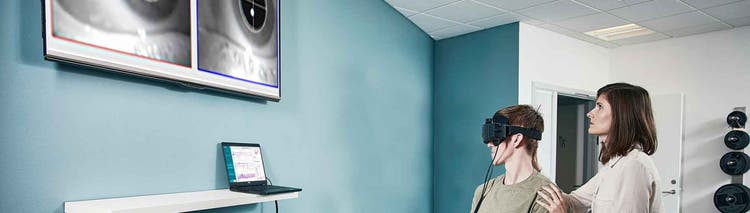
Video Frenzel goggles, also known as infrared video goggles, can record and replay eye movements, both in fixation and eyes-covered conditions. They offer a large advantage over traditional Frenzel goggles, which could only enhance and magnify the eyes for bedside observation without fixation.
However, today’s diagnostics have moved beyond simple observation of eye movements. It is much more powerful to be able to measure and quantify the nystagmus. Quantification of a patient’s nystagmus allows not only for an accurate diagnosis but also an accurate measurement of a patient’s improvement throughout intervention and therapy.
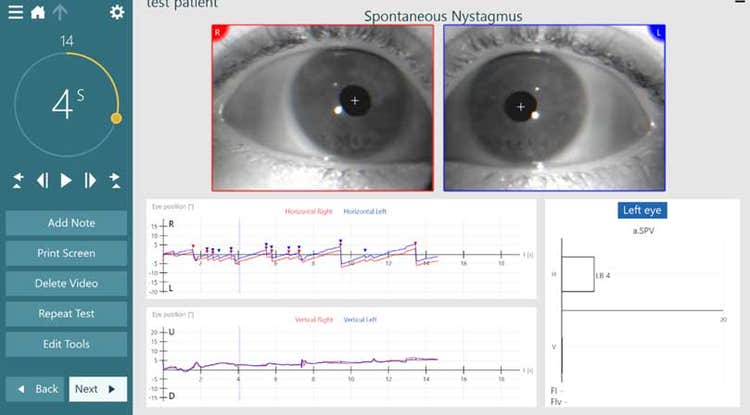
The powerful nystagmus detection algorithms in Interacoustics’ VisualEyes™ 505 can find and measure abnormal eye movements in the horizontal and vertical channels. If the software observes nystagmus in either channel, it will provide a numerical measurement to the right. A red diamond will appear if the amount of nystagmus is outside of the suggested threshold levels.
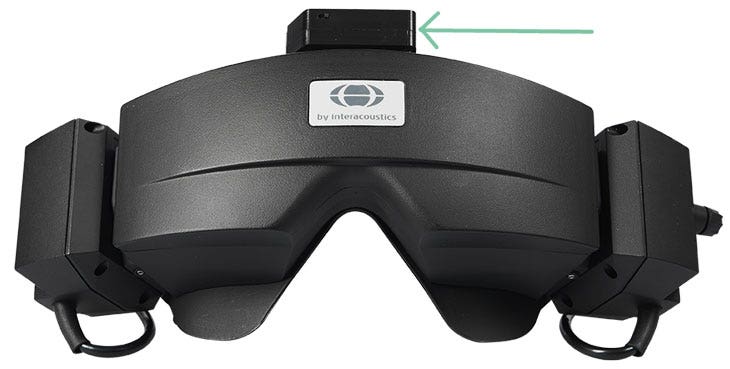
Bring your video goggles to a whole new level by adding a simple and small head sensor. As part of Interacoustics’ VORTEQ™ Assessment add-on bundle, the VORTEQ™ inertial measurement unit (IMU) head sensor measures head position in space and head speed.
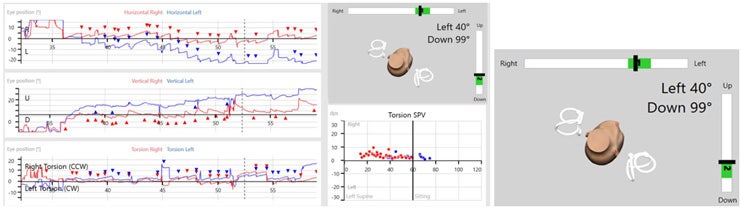
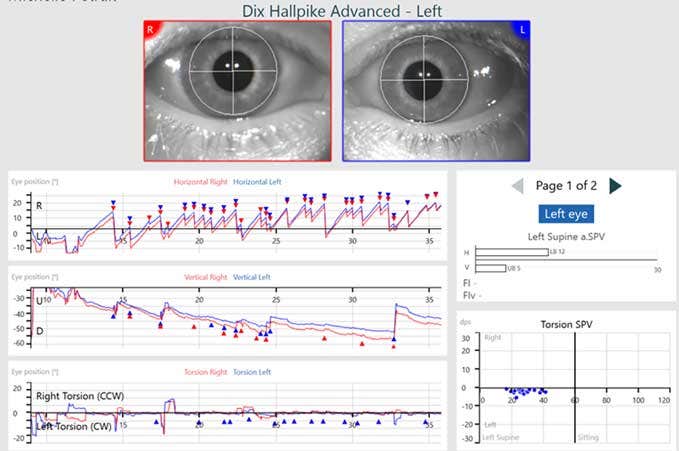
Measurement of head position is especially important for accurate diagnosis in the Advanced Dix‑Hallpike and Lateral Head Roll tests. These typical tests for benign paroxysmal positional vertigo (BPPV) need accurate observation of eye movements in response to specific head positions. A 3D head model provides real-time feedback and guidance for the accurate positioning of the head during testing or treatment.
Measurement of head speed is useful to quantify the function of the vestibular-ocular reflex (VOR). The VOR is one of the most important reflexes for everyday movements because it allows us to maintain clear vision when the head is in motion. Following vestibular injuries or insults, the VOR is one of the most frequently affected reflexes.
Luckily, specific intervention can usually rehabilitate and improve the VOR. To define the starting point for intervention, you can perform functional VOR tests such as Dynamic Visual Acuity (DVA), the Gaze Stabilization Test (GST), or the Functional Vision Head Impulse Test (fvHIT™). The head sensor allows for accurate measurement of head speed and provides real-time feedback so your testing can be exact.
The VORTEQ™ sensor allows you to measure torsional eye movements in addition to horizontal and vertical eye movements during Advanced Dix‑Hallpike testing. Previous videonystagmography (VNG) technology has not been able to be measure or quantify torsional eye movements, which are most often present in active BPPV cases.
Being confident in your diagnosis is so important to recommend and streamline treatment for your patients so they can improve as quickly as possible. Advanced diagnostic abilities, such as the measurements of head position and speed and the evaluation of torsional eye movements, allow for improved patient care.
Do more for your patients by improving your diagnostics and treatment. Add video goggles and a head sensor to your clinical flow.
For more information about this solution, visit Interacoustics’ VisualEyes™ 505.
Dr. Liz Fuemmeler, Au.D., is a Clinical Product Manager with Interacoustics and Vestibular Program Director at Professional Hearing Center in Kansas City, MO.