Solutions / Balance Testing Equipment / How to perform the Spontaneous Nystagmus test
How to perform the Spontaneous Nystagmus test
How to perform the Spontaneous Nystagmus test
Learn how to perform the spontaneous nystagmus test with videonystagmography (VNG) equipment.
VisualEyes™ Support
The spontaneous nystagmus test determines if the patient has any nystagmus, with or without fixation, when sitting with head and eyes in a neutral position. The presence of spontaneous nystagmus can affect all other VNG tests. Therefore, it is essential to identify the presence of spontaneous nystagmus prior to performing any other VNG tests.
“I am going to place a mask over the goggles. What I need for you to do is just look to where you think is straight ahead.” No other instruction is necessary, but it is recommended that alerting tasks be administered during the fixation-free portion of the test to help prevent the patient from suppressing any nystagmus if a response is present.
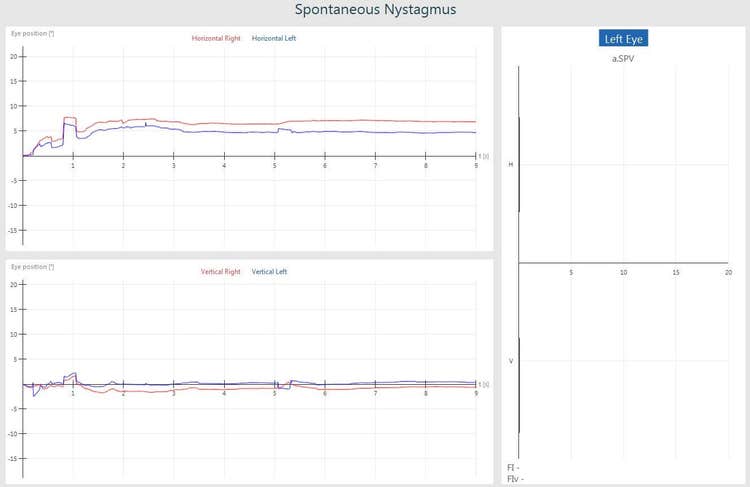
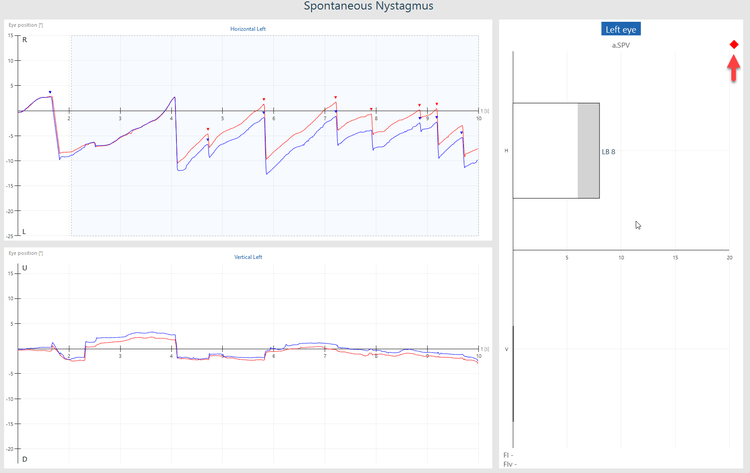
A patient with no spontaneous nystagmus will produce a tracing that is virtually a straight line. The right eye is represented by the red line and the left eye by the blue line. If nystagmus is present it will be identified by triangles on the graph to represent each detected nystagmus beat. The average slow phase velocity value(s) will be plotted in the bar graphs to the right of the tracings. When both a fixation-free and a fixation section have been completed in the spontaneous test, a fixation index (FI) percentage value will also be calculated. A yellow bar in the tracing indicates the fixation section.
Spontaneous test showing a normal response with no nystagmus detected in either the horizontal or vertical channels
An abnormal test result will reveal the presence of nystagmus in the horizontal and/or vertical channels. When the average slow phase velocity exceeds the threshold value of 6⁰/sec, the bar graph will be shaded grey and a red diamond will appear near the bar graph to indicate an out of threshold response.
Spontaneous test showing horizontal left-beating nystagmus
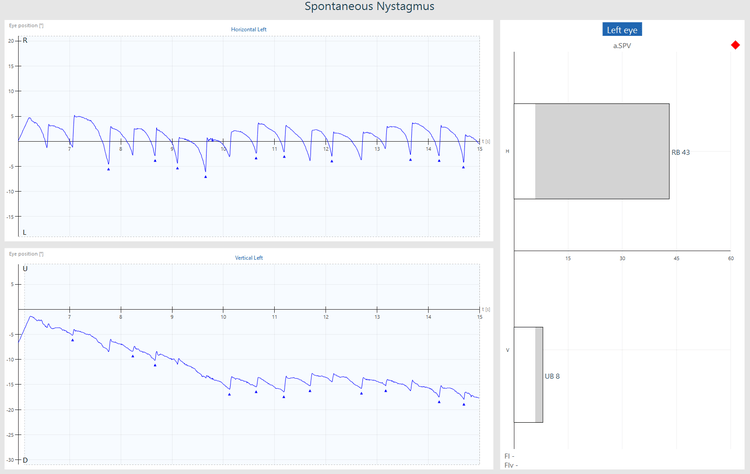
Spontaneous nystagmus test showing congenital nystagmus.
The assessment of spontaneous nystagmus is essential to the VNG battery because it affects all other tests within the VNG battery. The presence of spontaneous nystagmus may be further analyzed as an indication of central versus peripheral vestibular involvement. For a complete discussion of spontaneous nystagmus and its indications, refer to:
Contact your local distributor
Our world-wide experts are ready to help you find the right solution.