Solutions / Balance Testing Equipment / How to perform the Active Head Rotation test
How to perform the Active Head Rotation test

How to perform the Active Head Rotation test

Learn how to perform the active head rotation (AHR) test in the VisualEyes™ software.
Get a quote Find a distributor
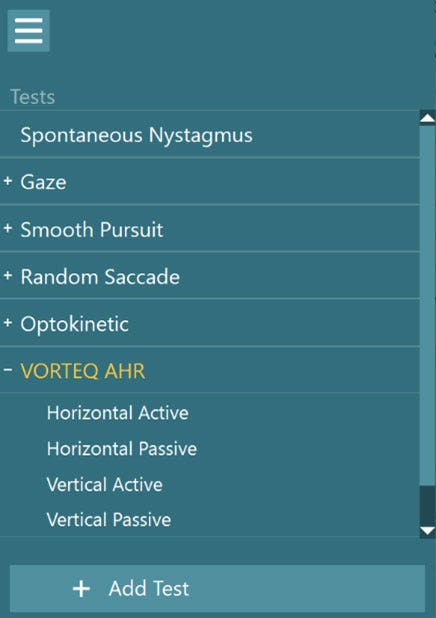
List of tests, including spontaneous nystagmus, gaze, smooth pursuit, random saccade, optokinetic, and VORTEQ active head rotation. For subtests for VORTEQ active head rotation are visible, including horizontal active, horizontal passive, vertical active, and vertical passive.

VisualEyes™ Support

The Active Head Rotation Test is useful when you have a bilateral caloric weakness, as it can provide information on the residual function of the vestibular system. If you have purchased the VORTEQ Diagnostics package, you will have license capabilities to perform Active Head Rotation (AHR) tests.

Figure 1 – License for VE525 and VORTEQ diagnostic bundle
To begin testing, select the first VORTEQ AHR subtest which is Horizontal Active. For active tests, the patient will be instructed to move their head to the beat of the metronome while fixating the target. In the default protocol, the target is a black dot on a white screen.
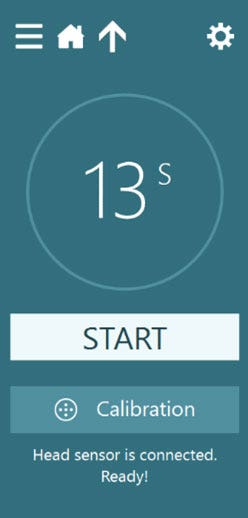
If you have not already calibrated in a previous test, you would need to calibrate before starting the test. If the eyes were already calibrated in a previous test, you are ready to begin and can hit start to begin the first subtest. Make sure the VORTEQ IMU is attached to the goggle and turned on. You will see a message telling you when the sensor is active, and you can begin testing.
Figure 2 – Message showing you the VORTEQ IMU is turned on and you are ready to start testing
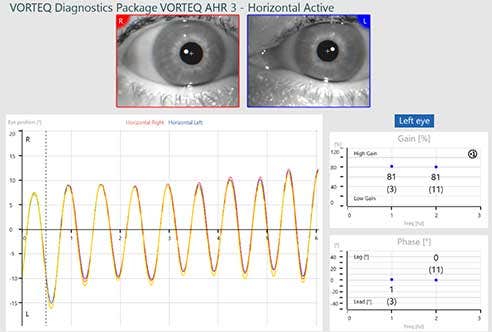
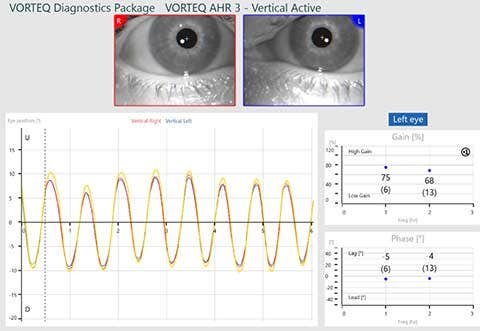
During the test, you will see the head movement shown in yellow, the eyes in red and blue, and the gain and phase measurements.
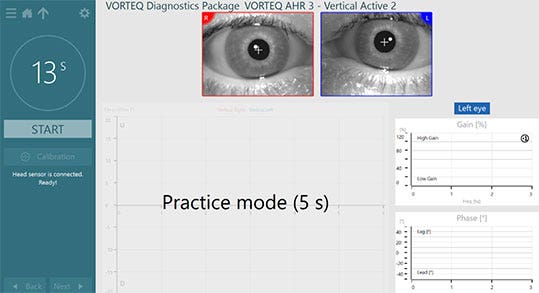
There will be a short practice mode to let your patient get used to the head movements at the speed of the metronome.
Figure 3 – Practice mode for Active Head Rotation testing
Vertical active subtest screen for VORTEQ active head rotation. Empty gain and phase graphs, and a greyed out eye position graph with the words 'Practice mode (5 s)'.

Horizontal active subtest screen for VORTEQ active head rotation. 81% gain at 1 and 2 hz. 1 degree phase lag at 1 hz. 0 degree phase at 2 hz. Smooth sinusoids for eye position that follow the target position nicely.

Vertical active subtest screen for VORTEQ active head rotation. 75% gain at 1 hz and 68% gain at 2 hz. 5 degree phase lead at 1 hz. 4 degree phase lead at 2 hz. Smooth sinusoids for eye position that fall a bit short of the target position.

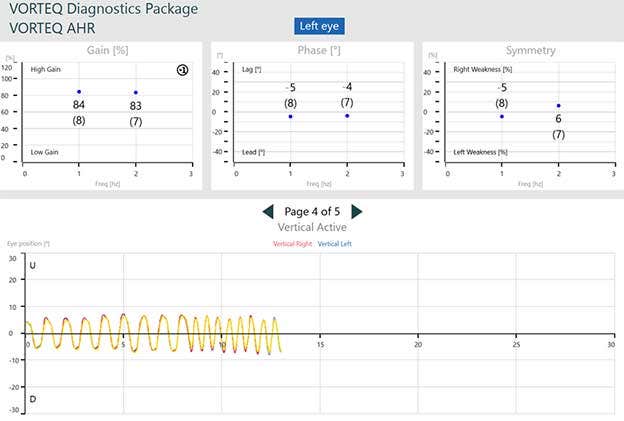
Summary plots for gain, phase, symmetry, and eye position. 84% gain at 1 hz and 83% gain at 2 hz. 5 degree phase lead at 1 hz and 4 degree phase lead at 2 hz. 5% left weakness at 1 hz and 6% right weakness at 2 hz. Eye position tracings follow the target position tracing quite closely.

Contact your local distributor

Our world-wide experts are ready to help you find the right solution.
Find a distributor