Solutions / Balance Testing Equipment / EyeSeeCam vHIT
EyeSeeCam vHIT
EyeSeeCam vHIT
The EyeSeeCam vHIT system provides a goggle and software for objective assessment of the vestibular-ocular reflex (VOR). Learn more.
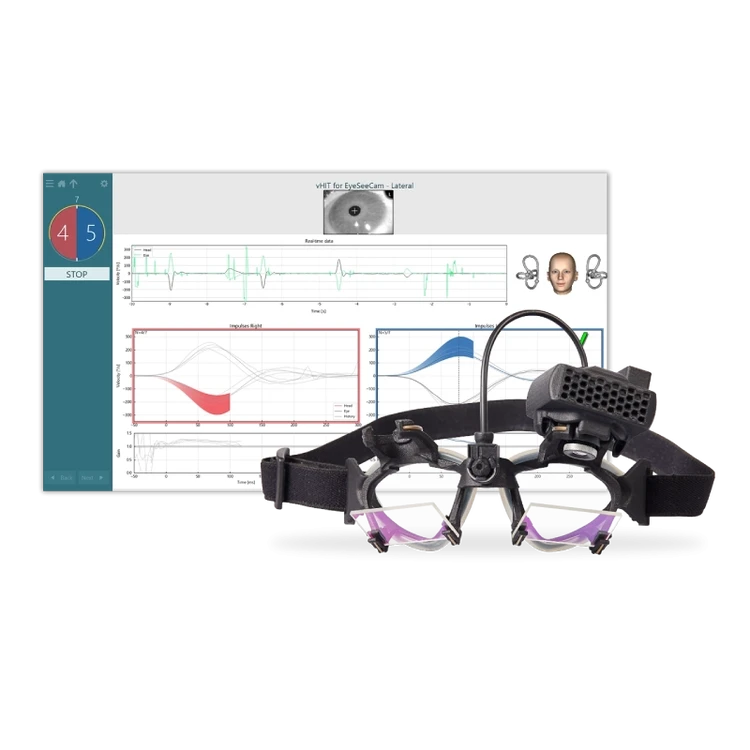
Perform objective head impulses
Test all six semicircular canals
Data export for clinical research
3D head model for objective feedback on the quality of head impulses
3D head model for objective feedback on the quality of head impulses
Real-time eye movements and head movements are displayed
EyeSeeCam vHIT features an easy guide to let you know when your head impulses are performed at the correct head velocity, which is 150-300 degrees per second. Feedback is given to indicate if your head impulses are in this range, visualized by a shaded area. Head impulses within the shaded area yield a 'ding' sound and a green check mark. Head impulses outside the shaded area yield a 'dong' sound and a red cross mark.
Covert saccades are not visible without video head impulse test (vHIT) hardware and software. Thus, the traditional bedside or clinical head impulse test (cHIT) is only able to identify overt saccades. Covert saccades are abnormal eye movements that occur during the (video) head impulse test. EyeSeeCam vHIT is able to capture and measure these eye movements, eliminating the risk of false negatives.
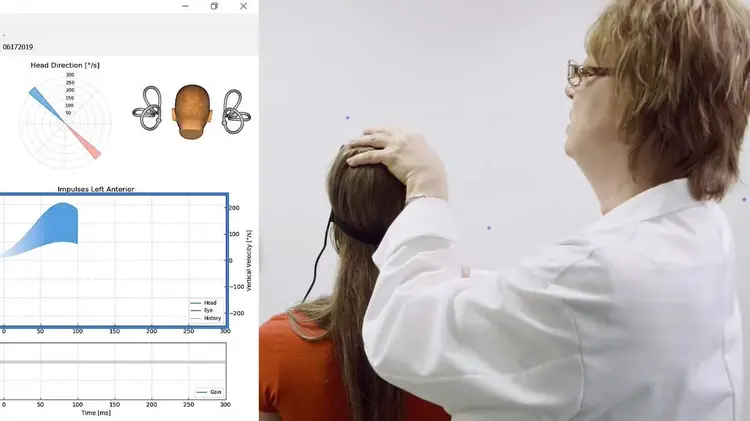
EyeSeeCam vHIT can be used to measure and display vestibular-ocular reflex (VOR) gains for all six semicircular canals. Vertical canals are tested by thrusting the patient’s head in the 45-degree planes while the patient continues to focus on the target in front of them. There are polar plots in the software to guide you and provide feedback to make sure you are thrusting in the correct planes.
Contact your local distributor
Our world-wide experts are ready to help you find the right solution.