Solutions / Audiometers / Threshold Equalizing Noise (TEN) Test
Threshold Equalizing Noise (TEN) Test
Threshold Equalizing Noise (TEN) Test
Learn how to perform the threshold equalizing noise (TEN) test with the AC40 clinical audiometer, including results interpretation.
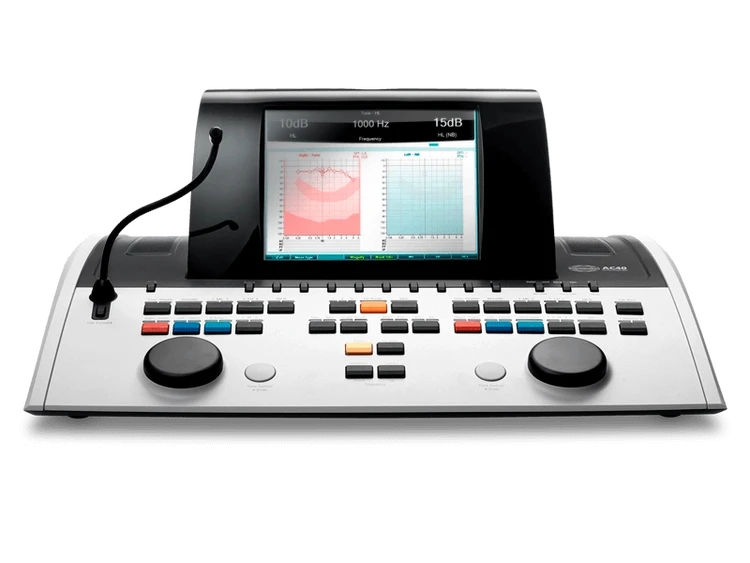
AC40 Support
Welcome to the product training for AC40 audiometer. On this page you will find an overview of all the available training materials and support.
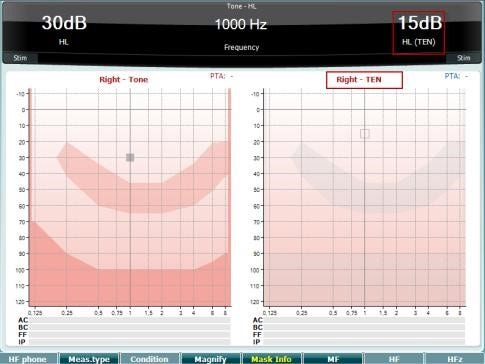
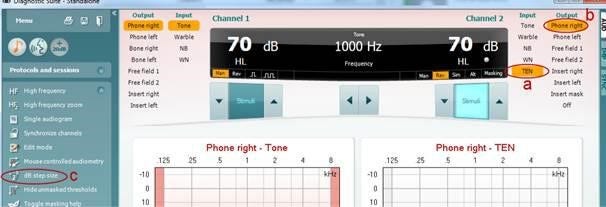
The threshold equalizing noise (TEN) test measures pure tone thresholds with a special masking noise called TEN.The TEN test is a quick and easy way to identify cochlear dead regions.
A dead cochlear region is defined as a region of the cochlea where there are no functioning inner hair cells and/or neurons (Moore, 2001). When a pure-tone signal “falls” into a dead region, it can be heard by neighbouring hair cells, if the intensity of the signal is loud enough. This is because the pure tone produces sufficient basilar-membrane vibrations in neighbouring areas of the cochlea, where there are surviving IHCs and neurons. This phenomenon is defined as “Off Frequency Listening”. Clinically, this will be presented as a threshold on the traditional pure tone audiogram, but it may not be the real threshold. It is not possible to use traditional pure tone audiometry to determine if there is a dead region present; the TEN test was developed for this very purpose.
Characteristics that could indicate the presence of a cochlear dead region (Moore, 2009):
Severe to profound hearing loss
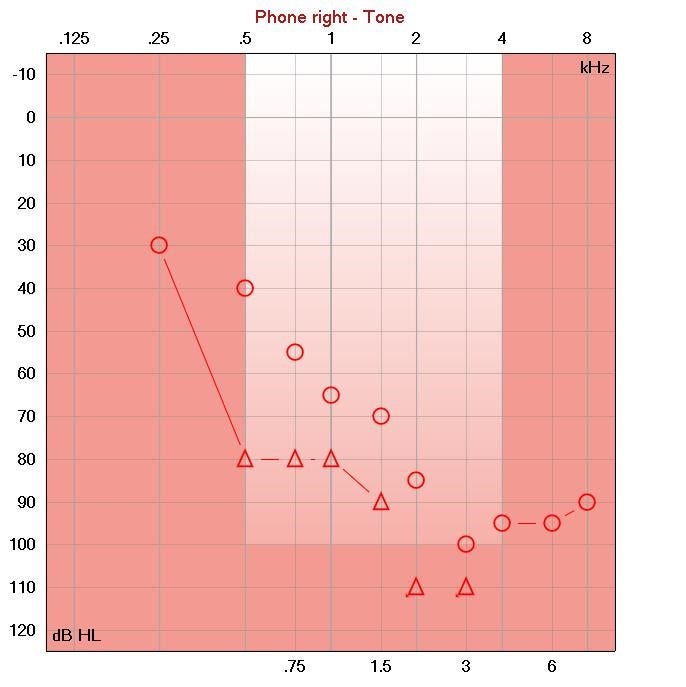
Absolute threshold at a specific (suspected) frequency is 70dB HL or greater
Steeply sloping hearing loss
Extremely poor speech discrimination
Contact your local distributor
Our world-wide experts are ready to help you find the right solution.