AC40 Support
Welcome to the product training for AC40 audiometer. On this page you will find an overview of all the available training materials and support.
Speech audiometry, also known as speech testing, employs speech signals to assess if the patient has problems hearing speech or speech in noise. Speech audiometry can be used to examine the processing ability and if it is affected by disorders of the middle ear, cochlea, auditory nerve, brainstem pathway, or auditory centers of the cortex.
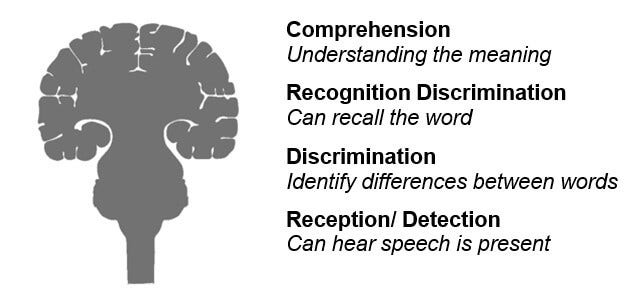
There is a variety of tests available with speech testing with the basic speech audiometry being an assessment of the reception, discrimination and recognition of speech. Reception refers to the level at which the patient can hear speech is present, discrimination refers to the level at which the patient can discriminate between words, while recognition refers to the level at which the patient can recognize and recall the word.
More advanced speech testing takes into account how speech is understood in the presence of noise, with various noise types such as white noise, speech noise, babble noise, or running speech as noise source and provide information about the signal-to-noise ratio (SNR) at which the patient can understand speech. Other components such as the placement of the speech signal in relation to the noise source and the tonal differences between the speech signal and the masking signal, is some of the things incorporated into more advance speech testing.
The speech detection threshold (SDT) is the level at which speech is audible to a person in 50% of the cases. It serves as a valuable cross-check for air conduction audiometry, and should closely align with the pure tone average (PTA). The PTA is typically calculated by averaging the thresholds obtained at 500, 1000, and 2000 Hz. A difference between the PTA and SDT of ±6 dB is good, ±7 to 12 dB is adequate, while ±13 dB or more is poor.
Note: Speech detection threshold is sometimes referred to as speech reception threshold abbreviated - SRT, not to be confused with speech recognition threshold, abbreviated - SRT. For that matter the term speech detection threshold is used and abbreviated – SDT.
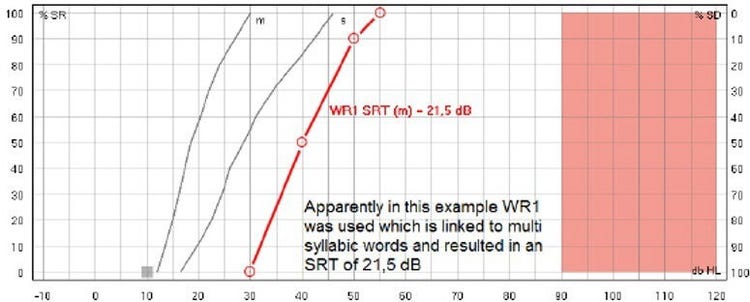
The speech recognition threshold (SRT) is the minimum hearing level at which an individual can correctly repeat 50% of the speech material, typically involving numbers or spondaic words. This measure serves as an indicator of hearing sensitivity for speech and provides a baseline for other assessments like Word Recognition (WR) tests, enabling the determination of appropriate starting points for further evaluations.
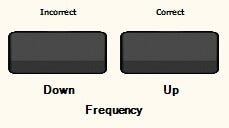
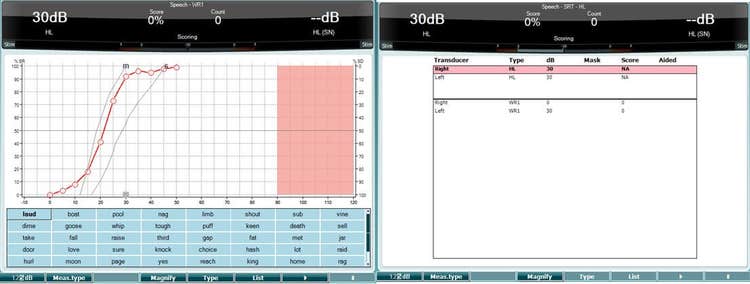
The word recognition score (WR) is sometimes also referred to as SDS (speech discrimination score) and represents the number of words correctly repeated, expressed as a percentage of correct (discrimination score) or incorrect (discrimination loss). Pressing correct means the word is a 100% correct, while incorrect correspond with 0% correct.The score can be obtained as a phoneme score that provides information about what phonemes the patient has difficulty hearing at a particular intensity level. This is helpful for counselling and rehabilitation purposes.