Solutions / Audiometers / Audiometric Masking
Audiometric Masking
Audiometric Masking
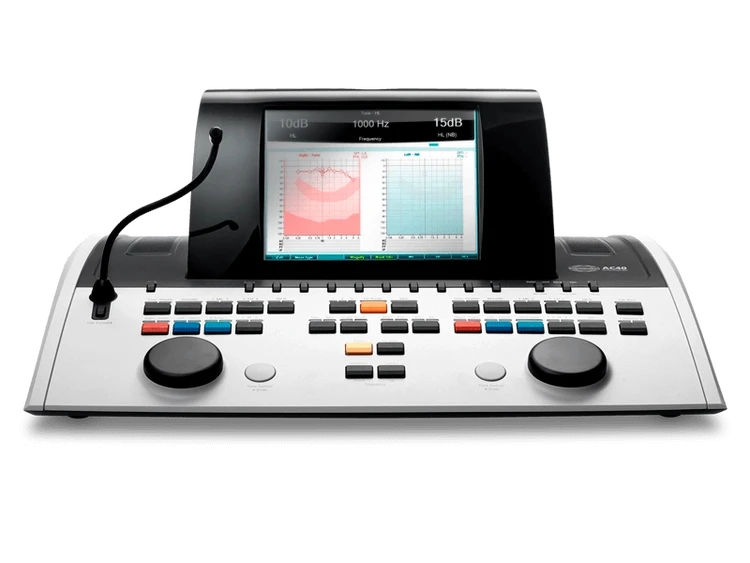
Learn how to perform audiometric masking with the AC40 clinical audiometer.
AC40 Support
Welcome to the product training for AC40 audiometer. On this page you will find an overview of all the available training materials and support.
In cases where you detect a symmetrical hearing loss, traditional audiometry without masking is usually sufficient. However, be aware that in cases of asymmetrical hearing loss, one cannot be certain that the intended ear is the one actually detecting the sound.
Audiometric masking is the process of presenting masking noise to the non-test ear while testing the other ear. Audiometric masking prevents asymmetrical hearing loss causing an erroneous measurement and can be applied in air conduction, bone conduction, and speech audiometry. Masking the better hearing ear is essential in audiometry, considering the concept of interaural attenuation.
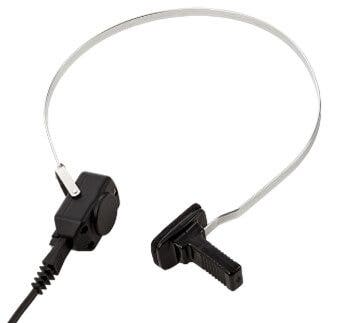
Interaural attenuation is the amount of attenuation the sound is exposed to on its way through the skull. Even though the interaural attenuation is very individual and varies with frequency, it is estimately a minimum of 40 dB for supra-aural headphones and 50 dB for inserts. Regarding bone conduction, the interaural attenuation is a minimum of 0 dB, which means that crossing over of the stimulus may occur at all times, and this is what one should assume.
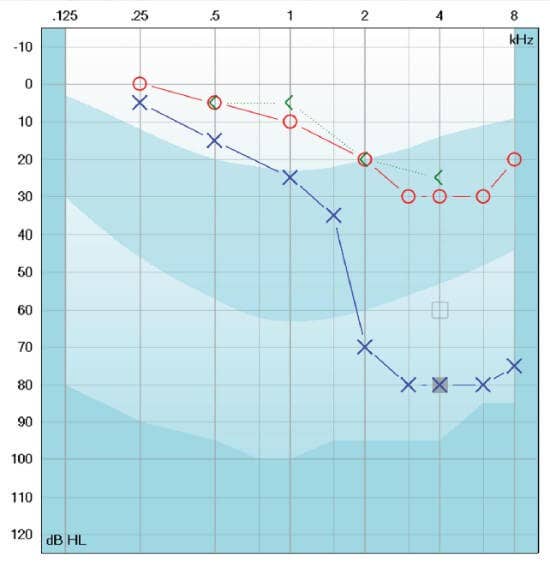
When measuring an audiogram on a patient with hearing within the normal range on one ear, but a moderate to severe hearing loss on the other, there is a potential risk of the good ear hearing the tone when trying to test the damaged ear. That is, the sound vibration may travel through the head and be heard by the opposite good ear when the vibrations of the signal are of sufficient magnitude. Therefore, you are actually measuring the thresholds from the wrong ear. This could be the case in the example here and masking is needed in the right ear (better ear) while reassessing the left (poorer ear).
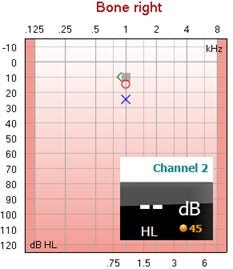
Masking is also needed to differentiate between sensorineural and conductive or mixed hearing losses. In the example, it is unknown if the loss of the left ear is sensorineural, conductive or a mixed hearing loss. The origin will be revealed by obtaining the bone conduction threshold for the left ear while occupying the right ear with masking.
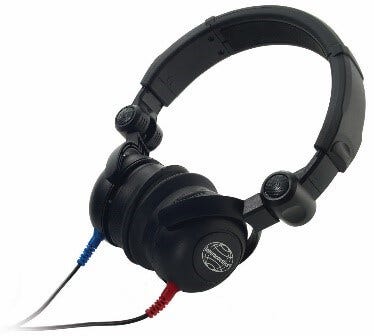
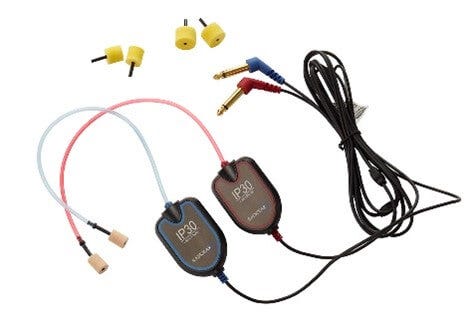
Headphones or insert phones
Perform air conduction audiometry unmasked for both ears.
Contact your local distributor
Our world-wide experts are ready to help you find the right solution.