Solutions / Audiometers / Alternate Binaural Loudness Balance Test
Alternate Binaural Loudness Balance Test
Alternate Binaural Loudness Balance Test
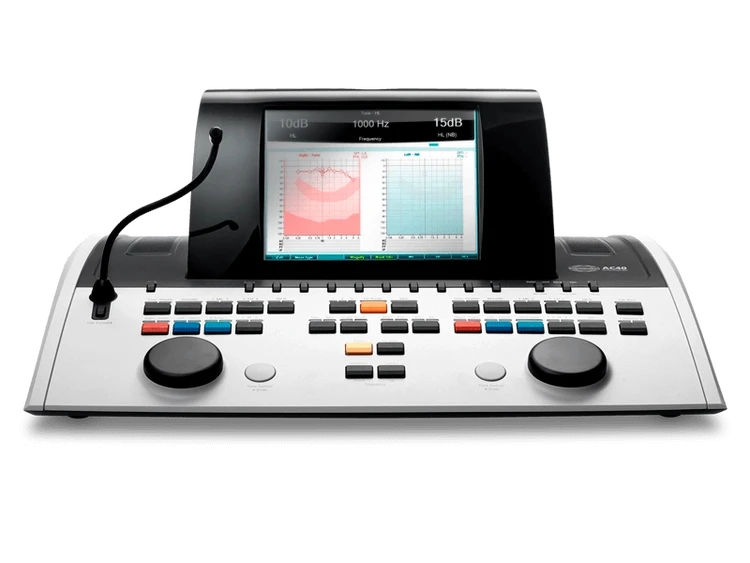
Learn how to perform the alternate binaural loudness balance (ABLB) test with the AC40 clinical audiometer, including results interpretation.
AC40 Support
Welcome to the product training for AC40 audiometer. On this page you will find an overview of all the available training materials and support.
The alternate binaural loudness balance (ABLB) test measures the perceived loudness differences between the ears and is designed for people with unilateral hearing loss. It serves as a possible test for recruitment. The test is interpreted by assessing the loudness differences at high intensity levels. If the loudness perception is at the same intensity level for both ears complete recruitment has occurred in the hearing-impaired ear. Decruitment may occur in case of a retro cochlear disorder. In these cases, loudness in the impaired ear increases more slowly that for the normal hearing ear (Stack 1998).
The same tone is presented alternatively to both ears. The intensity is fixed in the impaired ear (20 dB above pure tone threshold). The task of the patient is to adjust the level of the better ear until the signal in the two ears is of equal intensity. Note however that the test may also be performed by fixing the intensity in the normal hearing ear and having the patient set the tone for the impaired ear.
Headphones or insert phones
Clarify the test procedure to the patient. Explain that he/she will now hear tones in both ears, which will be presented alternatively in each ear. The patient should then inform the audiologist when the two tones sound equal in intensity/loudness.
Press and hold the Tests button and use the scroll wheel on the audiometer to select the ABLB – Fowler.
The Man Rev button on the audiometer is set to Rev. This will ensure continuous presentation of the tones, without having to stimulate manually.
The ABLB is performed at frequencies where recruitment is assumed. Set the intensity level on the impaired ear to 20 dB above the pure tone threshold using channel 2.
Contact your local distributor
Our world-wide experts are ready to help you find the right solution.