Solutions / Act / How to perform the ACT™ test (step-by-step)
How to perform the ACT™ test (step-by-step)

How to perform the ACT™ test (step-by-step)

In this step-by-step guide, you'll learn how to perform the Audible Contrast Threshold (ACT™) test, including pre- and post-test guidance, equipment, and...
Get a quote Find a distributor
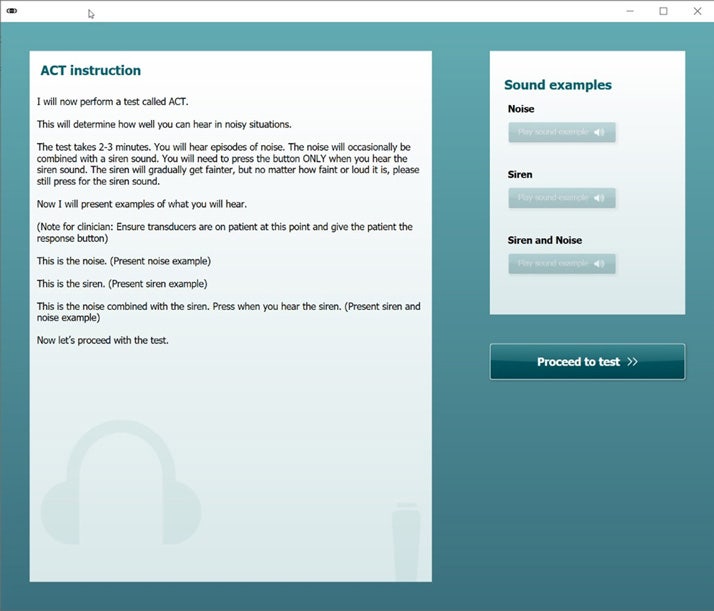
The instructions read as follows: I will now perform a test called ACT. This will determine how well you can hear in noisy situations. The test takes two to three minutes. You will hear episodes of noise. The noise will occasionally be combined with a siren sound. You will need to press the button only when you hear the siren sound. The siren will gradually get fainter, but no matter how faint or loud it is, please still press for the siren sound. Now I will present examples of what you will hear. Note for clinician: Ensure transducers are on patient at this point and give the patient the response button. This is the noise. Present noise example. This is the siren. Present siren example. This is the noise combined with the siren. Press when you hear the siren. Present siren and noise example. Now let’s proceed with the test.

ACT™ Support

In this quick guide, you will learn how to perform the Audible Contrast Threshold (ACT) test.
The ACT test is an above-threshold, non-language specific test that quantifies a person’s real‑world ability to hear in noise. The test applies the shape and levels of the audiogram to ensure the correct stimulus intensity is applied.
You can perform ACT on any adult client that you deem suitable to perform pure tone audiometry. It may be useful to counsel the client on the reason for performing ACT. Here, you will find an example script.
“We will perform a test called ACT. The result from this test will clarify your abilities to hear in background noise. This can be challenging, particularly if you have a hearing loss. So, performing this test will help me to know to what degree this is also a challenge for you.”
To perform an ACT test, you will need:
Affinity Compact, Equinox Evo, or Callisto™
Connected PC and keyboard
Headphones or insert earphones

Percent symbol labeled with the action to toggle graphs. ‘i’ symbol labeled with the action to show instruction screen.

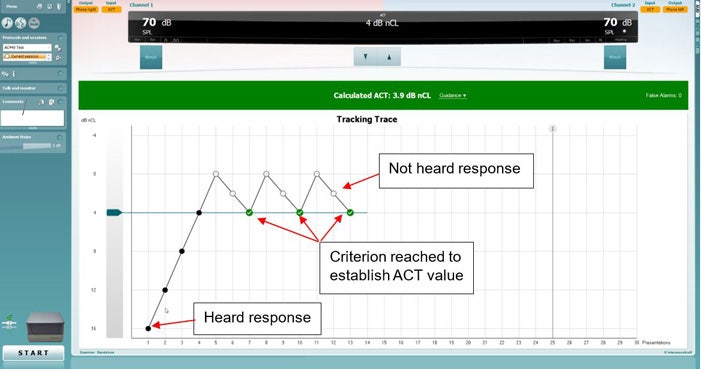
ACT test screen in the software. The patient has a calculated ACT value of 3 point 9 dB nCL. The graph has dB nCL as a function of presentations. The presentations at 16, 12, 8, and 4 dB nCL were all heard on the first try. Following, the patient was unable to hear the presentations at 0 and 2 dB nCL. The patient then hears the stimulus correctly at 4 dB nCL. This process repeats itself two times, leaving the patient with an ACT threshold value of 3 point 9 dB nCL.

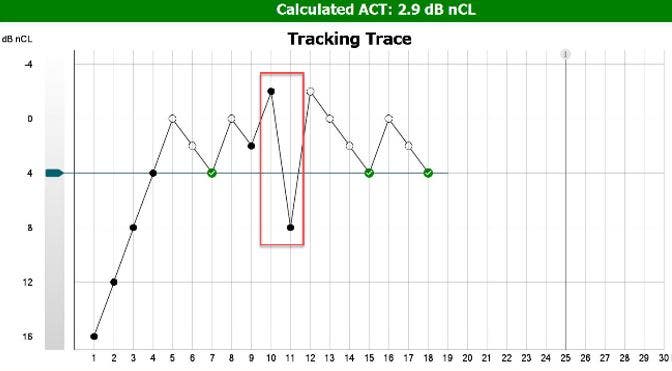
ACT test screen in the software. The patient has a calculated ACT value of 2 point 9 dB nCL. The graph has dB nCL as a function of presentations. The presentations at 16, 12, 8, and 4 dB nCL were all heard on the first try. Following, the patient was unable to hear the presentations at 0 and 2 dB nCL. The patient then hears the stimulus correctly at 4 dB nCL. The patient is again unable to hear the stimulus at 0 dB nCL, but then goes on to press the response button at 2 dB nCL and minus 2 dB nCL. Suspecting a false positive, the clinician in this case then presents a stimulus at 8 dB nCL, 4 dB nCL above the expected threshold of 4 dB nCL. Following, the patient follows the expected threshold, unable to hear stimuli that are less than 4 dB nCL.

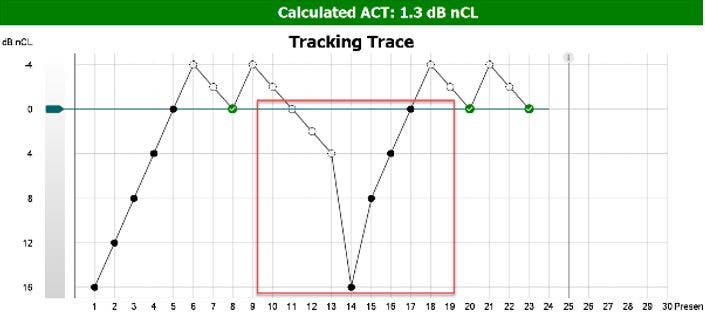
ACT test screen in the software. The patient has a calculated ACT value of 1 point 3 dB nCL. The graph has dB nCL as a function of presentations. The presentations at 16, 12, 8, 4, and 0 dB nCL were all heard on the first try. Following, the patient was unable to hear the presentations at minus 4 and minus 2 dB nCL. The patient then hears the stimulus correctly at 0 dB nCL. The patient then goes on to not press the response button all the way up to 4 dB nCL. Suspecting the patient has lost their concentration, the clinician in this case then presents a stimulus at 16 dB nCL. Following, the patient follows the expected threshold, unable to hear stimuli that are less than 0 dB nCL.

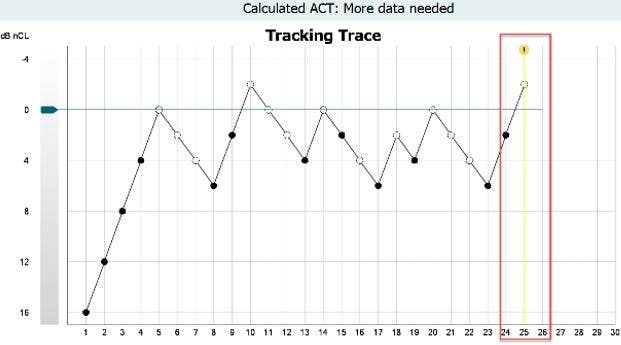
ACT test screen in the software. The patient has no calculated ACT value due to more data needed. The graph has dB nCL as a function of presentations. The patient’s expected threshold seems to be about 2 dB nCL, but the three out five criterion hasn’t been met yet after 25 stimulus presentations.

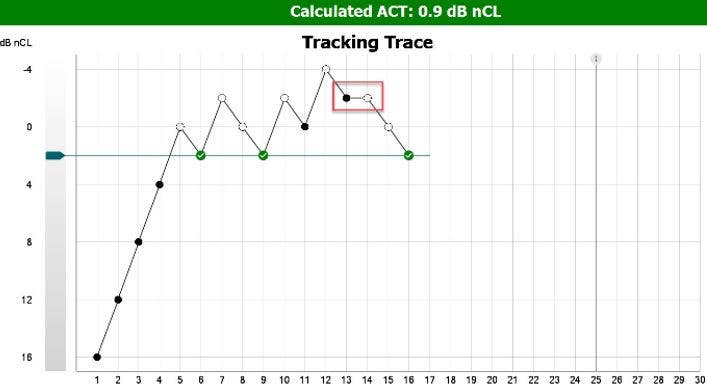
ACT test screen in the software. The patient has a calculated ACT value of 0 point 9 dB nCL. The graph has dB nCL as a function of presentations. The presentations at 16, 12, 8, and 4 dB nCL were all heard on the first try. Following, the patient scores correctly at 2 dB nCL two times, having been unable to hear below this level. However, the patient then goes on to supposedly hear the stimulus at 0 and minus 2 dB nCL. Suspecting a false response at minus 2 dB nCL, the clinician repeats the stimulus at this level. The patient fails to respond and ultimately scores correctly at 2 dB nCL for a third time.

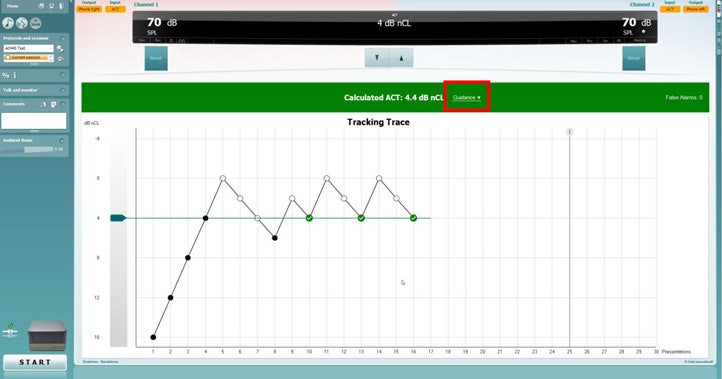
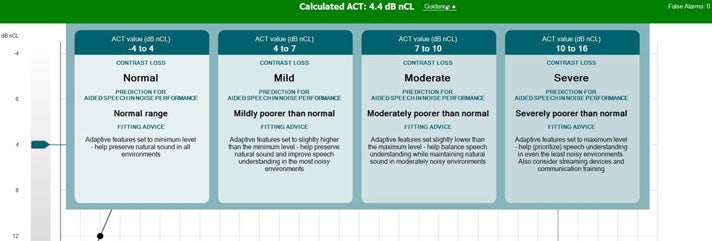
For normal contrast loss, which corresponds to an ACT value between minus 4 to plus 4 dB nCL, the advice reads: Adaptive features set to minimum level – help preserve natural sound in all environments. For mild contrast loss, which corresponds to an ACT value between 4 to 7 dB nCL, the advice reads: Adaptive features set to slightly higher than the minimum level – help preserve natural sound and improve speech understanding in the most noisy environments. For moderate contrast loss, which corresponds to an ACT value between 7 to 10 dB nCL, the advice reads: Adaptive features set slightly lower than the maximum level – help balance speech understanding while maintaining natural sound in moderately noisy environments. For severe contrast loss, which corresponds to an ACT value between 10 to 16 dB nCL, the advice reads: Adaptive features set to maximum level – help prioritize speech understanding in even the least noisy environments. Also consider streaming devices and communication training.

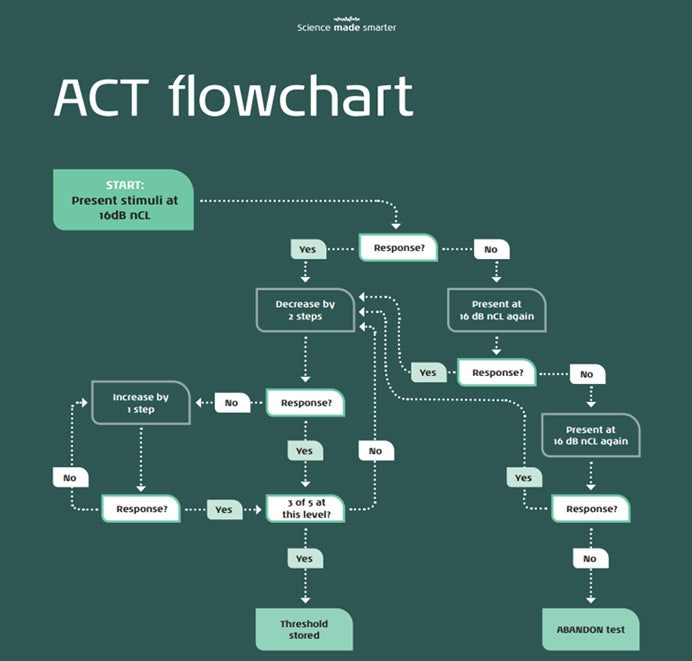
Complex flowchart describing how to perform the ACT test. The first step is to present the stimulus at 16 dB nCL. If there is no response, present at 16 dB nCL again. If there is still no response, present at 16 dB nCL again. If there is still no response the third time, abandon the test. If there is a response on either the first, second, or third presentation at 16 dB nCL, decrease by two steps. If there isn’t a response after decreasing by two steps, increase by one step. If there still isn’t a response, increase by one step. If there is a response after the first time increasing by one step, the three out of five criterion determines either the threshold or whether to decrease by two steps. Going back to the initial decrease by two steps. If there is a response after decreasing by two steps, the three out of five criterion determines either the threshold or whether to decrease by two steps.

Contact your local distributor

Our world-wide experts are ready to help you find the right solution.
Find a distributor