The alternate binaural loudness balance (ABLB) test is an assessment of whether a patient perceives loudness differently in each ear.
The alternate binaural loudness balance (ABLB) test, also known as the Fowler test or the Fowler ABLB test, is an assessment of whether a patient perceives loudness differently in each ear. The test involves the patient comparing the loudness of sounds presented to each ear and signaling whether they are of equal loudness, or whether the sound in one ear is louder (to them) than in the other ear.
You can use the ABLB test to identify recruitment, where the patient experiences a reduced dynamic range and a rapid growth in the perception of loudness. Recruitment is often caused by cochlear damage and so can be present in patients with sensorineural hearing loss.
In cases of unilateral hearing loss, you can use the ABLB test to identify recruitment in the poorer hearing ear. This requires normal hearing thresholds in the better ear to ensure you are using normal loudness growth to compare against the poorer ear’s loudness growth.
If you present a sound to both ears at the same intensity and the patient perceives the loudness to be the same in both ears, then this indicates recruitment has occurred in the poorer hearing ear. A non-recruiting hearing loss would present with a linear increase in loudness perception upon increasing intensity level.
You need the following to perform the ABLB test:
Headphones or insert earphones
Audiometer with functionality for ABLB
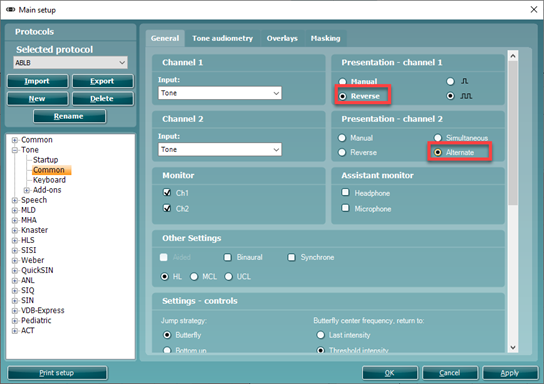
Select an ABLB protocol. If you have not created such a protocol, follow the steps below to do so (when using Interacoustics software):
Go to Menu | Setup | AC440 setup.
Press New to create a new protocol.
Name the new protocol ABLB or similar for easy future identification.
From the left-hand menu, select Tone | Common.
Under Presentation – channel 1, select Reverse and Multi pulse (the waves right next to Reverse in Figure 1).
Under Presentation – channel 2, select Alternate.
Ensure both Channel 1 and Channel 2 input is set to Tone.
Instruct the patient that they will hear tones in both ears, presented alternatively in each ear. They should press the patient response button (or otherwise indicate to you) when the two tones sound equal in loudness in both ears.
Select the tone or tones to test based on which frequencies you suspect recruitment. The tones selected should be frequencies at which there is a significant asymmetry in the hearing loss.
In channel 2, set the intensity level of the tone in the poorer hearing ear to be 20 dB above the pure tone threshold (20 dB sensation level). This level won’t be changed in this ear during the test. Advise the patient that the tone in this ear will be present as a continuous signal as soon as they put the headphones on. The level of the tone in the better hearing ear (channel 1) will be varied during the test.
Note: You can also perform the ABLB test the opposite way around, with a fixed intensity level used in the better hearing ear at 20 dB sensation level, and the level of the tone in the poorer hearing ear varied during the test.
Set the intensity level in channel 1 to a low but audible level. Press the present button for channel 1. This will present the tone in the test ear and switch off the continuous tone in the fixed non-test ear. Increase the intensity level of the tone in channel 1 by 5-dB increments until the patient presses the response button, as instructed.
When the patient indicates that the loudness of the tone in the test ear (channel 1) is the same as the loudness in the non-test ear (channel 2), record the response level.
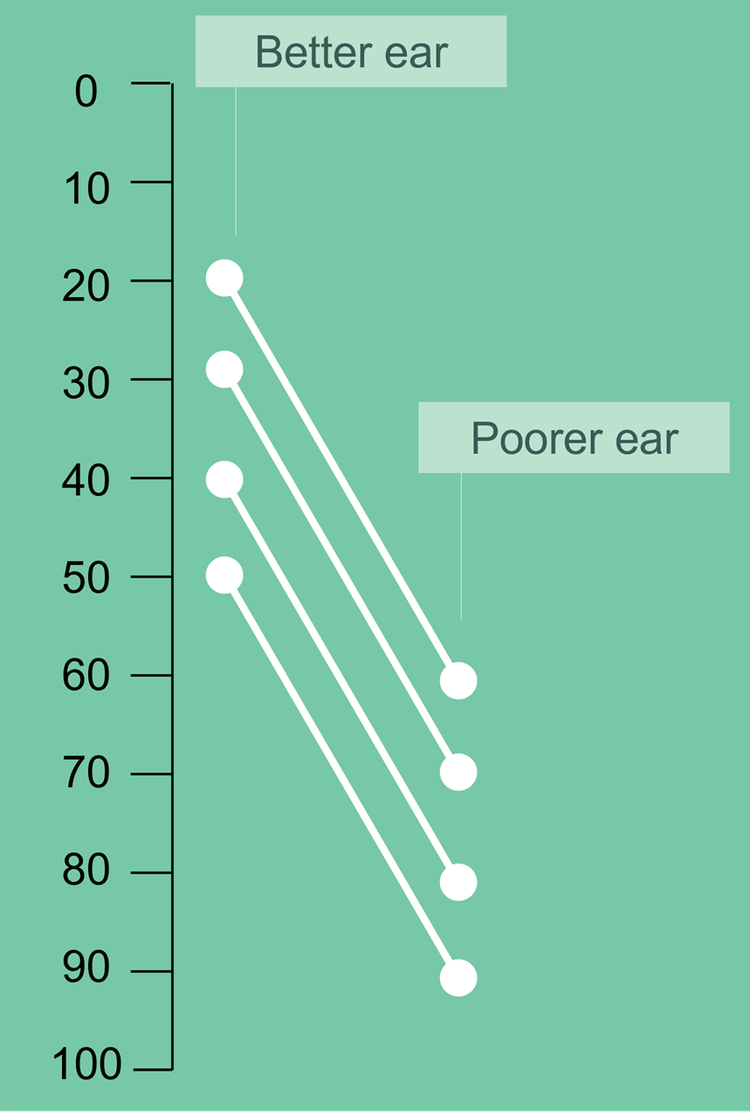
Repeat the above process with different sensation levels (increase by 10 dB increments) in the non-test (channel 2) ear. The balanced level in the test ear should be recorded on a laddergram for each sensation level in the non-test ear (Figure 2).
Move on to test further frequencies required in the same manner.
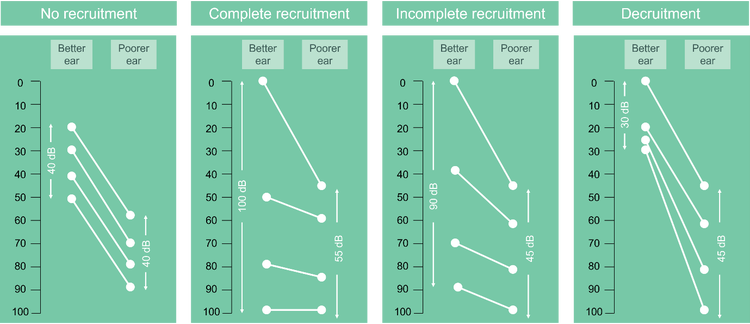
The ABLB test results can provide information on whether the loudness growth in the poorer ear is abnormal, by comparing to the loudness growth in the better ear. Visual inspection of the laddergram can help with this. See Table 1 and Figure 3 for the different types of ABLB results.
Table 1: Types of ABLB test results.
Carver, W. F. (1972). Loudness balance procedures. In J. Katz (Ed.), Handbook of clinical audiology. Williams & Wilkins.
Carver W. F. (1970). The reliability and precision of a modification of the ABLB test. The Annals of otology, rhinology, and laryngology, 79(2), 398–411.
Hood, J. D. (1977). Loudness balance procedures for the measurement of recruitment. Audiology, 16(3), 215–228.
JERGER, J. F., & HARFORD, E. R. (1960). Alternate and simultaneous binaural balancing of pure tones. Journal of speech and hearing research, 3, 15–30.
Stach, B. A. (1998). Clinical audiology: An introduction. Cengage Learning.
railCourse details
- Format: Reading
- Clinical area: Audiometry