Solutions / ABR Equipment / Cochlear Microphonics
Cochlear Microphonics
Cochlear Microphonics
Learn how to measure cochlear microphonics with the Eclipse device.
Eclipse Support
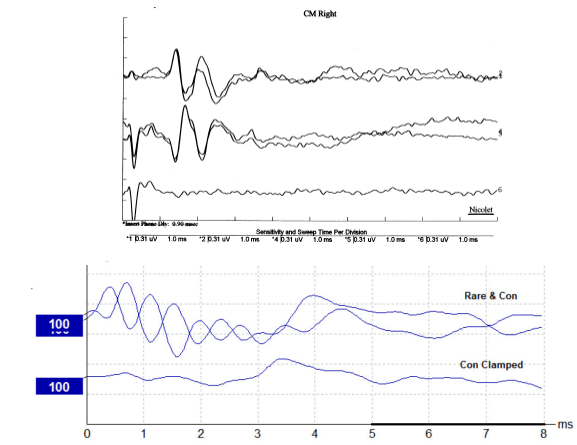
The cochlear microphonic is a response from the cochlea that mimics the input stimulus and is believed to be a response primarily from the outer hair cells (Dallos, 1983).
The presence of a cochlear microhpnic along with an absent or abnormal ABR is used in the diagnosis of auditory neuropathy spectrum disorder (ANSD). When a click ABR or CE-Chirp® LS is not present or abnormal, it is common to perform a cochlear microphonic test. Determining the presence or absence of the cochlear microphonic (OHC response) is an important part of the ANSD test battery.
The patient should be relaxed or sleeping in a quiet environment and lying down during the procedure.
It is possible to obtain cochlear microphonics with a standard ABR electrode montage, however the strongest signal will be obtained with electrodes positioned from a point as close to the site of generation as possible. The most commonly used electrodes for this purpose are the gold foil TipTrodes or TM-trodes.
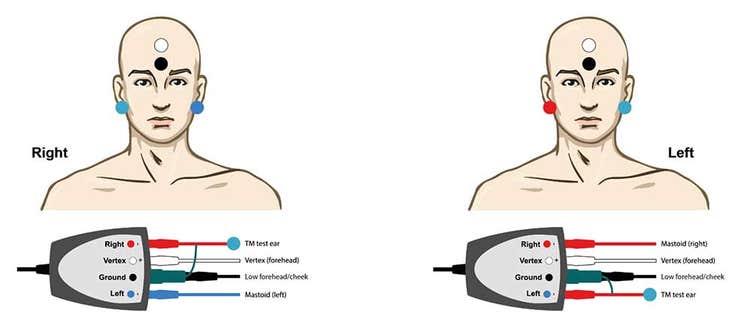
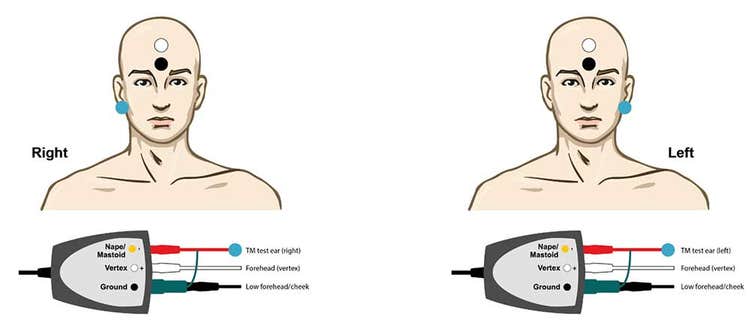
Below are two examples of electrode placements
Electrode placement using EPA4 with a TM-trode
Electrode placement using EPA3 with a TM-trode
For both examples the TM-trode and the test ear must be prepared prior to placing the TM-trode on the TM. To reduce impedance a solution of saline can be used. Drain the ear prior to inserting the TM-trode. The TM-trode can be placed in a saline solution for a few minutes prior to placing it on the TM and should be dipped in electrode contact gel (e.g. Sonaville) prior to placing it at the TM.

Contact your local distributor
Our world-wide experts are ready to help you find the right solution.