Solutions / ABR Equipment / Bayesian Weighting
Bayesian Weighting
Bayesian Weighting
Learn what Bayesian weighting is and when and why you should use it (and when it may be less relevant to use it).
Eclipse Support
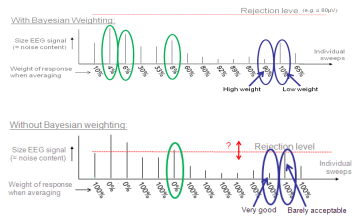
Bayesian weighting is a tool designed to assist the clinician when testing in less than optimal conditions. While giving sweeps with less noise a higher “score”, sweeps with more noise are not given the same level of importance in the overall recording. Each sweep is analysed and not simply accepted or rejected as with traditional averaging but is given a unique signficance based on its level of noise. Bayesian weighting can be used in all typical ABR testing situations and will be effective when EEG levels vary during recording.
As Bayesian weighting does not change the response of a waveform, you may use it in all typical ABR recording situations.
The optimum use of all data reduces test time. More stable recordings, as residual noise will never suddenly rise (and a good waveform deteriorate) during recording, even if patient starts to be uneasy. The difficulty of selecting the optimum rejection rate is reduced, as a softer rejection rate can be used without the noisier sweeps contaminating the more quiet sweeps.
The optimum use of all data reduces test time.
More stable recordings, as residual noise will never suddenly rise (and a good waveform deteriorate) during recording, even if patient starts to be uneasy.
The difficulty of selecting the optimum rejection rate is reduced, as a softer rejection rate can be used without the noisier sweeps contaminating the more quiet sweeps.
Bayesian weighting weights noisy sweeps less and quiet sweeps more. In a situation where all sweeps are the same, they will be weighted equally. This is identical to normal averaging. Hence, there is no difference between recordings with and without Bayesian weighting.
In this case, all noisy sweeps are simply rejected for both Bayesian and non-Bayesian recordings. Only the most quiet sweeps are accepted, and you have a situation almost similar to above. With softer rejection criteria (e.g. 80µV) you would benefit from the contributions of the more noisy sweeps in your averaging thus arriving at your desired residual noise level in less time.
Contact your local distributor
Our world-wide experts are ready to help you find the right solution.