Eclipse Support
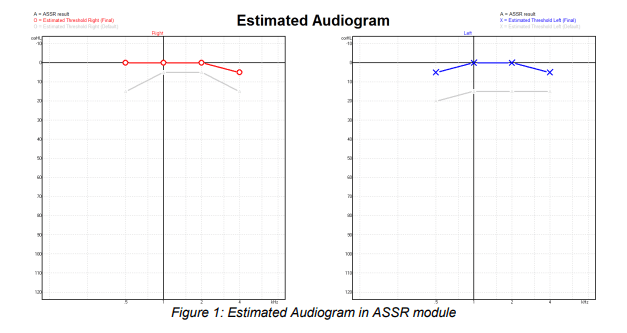
The auditory steady-state response (ASSR) is an electrophysiological response that is evoked by a periodically repeated (rapid) auditory stimulus. An ASSR typically uses frequency specific stimuli (0.5, 1, 2, 4 kHz) with the goal of creating an estimated audiogram. In other words, it is a test used for performing a threshold assessment.
Unlike auditory brainstem response (ABR) which looks at amplitude and latency of the response in the time domain, ASSR looks at amplitudes and phases in the frequency domain. Responses are detected using a statistic-based mathematical detection algorithm to determine if a response is present or not. Another difference is that while it is only possible to test one frequency per ear at a time in frequency-specific threshold ABR. ASSR allows for binaural testing; four frequencies in each ear at the same time (eight simultaneous presentations).
To convert the ASSR responses detected in nHL to eHL (estimated Hearing Levels), a correction factor is typically applied to each response to arrive at the final audiogram. Note that the estimated threshold cannot exceed 0dB eHL.
The ASSR technology is completely objective and based on statistical probability rather than subjective assessment of response waveforms. The most important audiological application of ASSR is to provide an estimate of the pure tone audiogram, which is used for rehabilitation purposes.
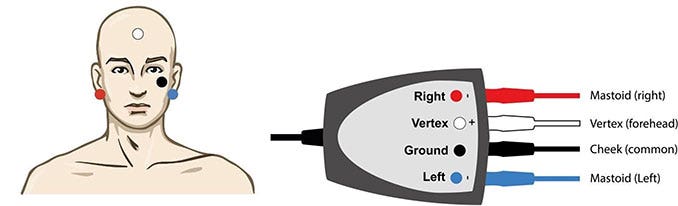
Patient preparation is very important. The electrode sites must be prepared and cleaned in order to obtain acceptably low skin impedance. It is recommended to have impedance values below 3kΩ or lower.
The same electrode placement for ASSR is also used for ABR allowing for easy switching between the test types.
Make sure that the patient is relaxed prior to starting the test. You can monitor this by watching the EEG. Window in the top right hand corner of the recording window. A relaxed patient will typically show black EEG curves within a ±40 volt rejection setting.
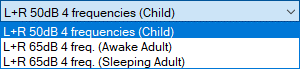
The Eclipse ASSR software comes with pre-programmed protocols, so the system is ready to use immediately. Protocols can be created or modified easily to fit your clinic need. Consult your manual to learn how to create or modify a protocol. The procedure described below is simply a suggested test process and to be used only as a guideline.