Solutions / ABR Equipment / ALR / Cortical Evoked Response Audiometry
ALR / Cortical Evoked Response Audiometry
ALR / Cortical Evoked Response Audiometry
Learn how to measure auditory late responses (ALRs) with cortical evoked response audiometry (CERA) using the Eclipse evoked potentials system. Read more.
Eclipse Support
Auditory Late Responses (ALRs) are longer latency components that for most part are generated in higher regions of the auditory CNS, including the auditory cortex.
Cortical evoked response audiometry (CERA) refers to the technique of measuring ALRs for the purpose of assessing hearing ability. The responses are typically measured using surface electrodes placed on the scalp of an individual.
CERA is traditionally used to help determine the degree of hearing loss in adult populations. Compared to traditional auditory brainstem responses (ABRs), or behavioral audiometry, ALRs demonstrate audibility at the cortex without the need for the listener to play an active role in the procedure. This is a key advantage in various medico-legal scenarios or in cases where the individual is unable or unwilling to provide accurate behavioral responses to a sound.
Other advantages include the relative robustness of the ALRs to myogenic activity, the high frequency specificity of the tonal stimuli due to their longer duration, and is much closer to the behavioral audiometric pure tone compared to traditional ABR octave wide stimuli, and the ability to calibrate the stimuli according to international standards (BS EN ISO 389 as for pure tone audiometers) and not the standard 389-6 used for Tone burst/Tone pips & Chirps .
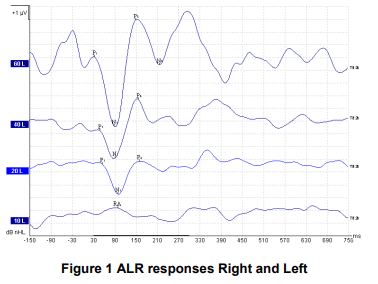
The key ALR waveforms observed in CERA are the P1, N1, and P2 responses. The ALR latency typically ranges from 50 – 300 ms and N1-P2 amplitude ranges from 0-20 µV. (see Figure 1, showing P1, N1 and P2 responses to a 2 kHz toneburst stimuli, used to provide a typical threshold recording from the left ear. In this case, hearing sensitivity is shown to be within the normal audiometric range.
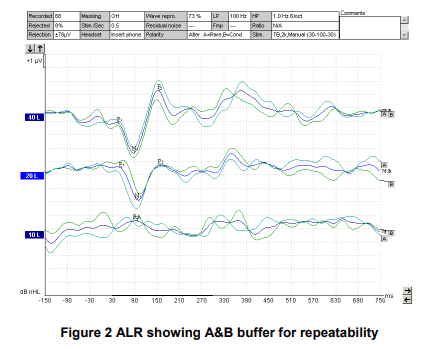
Patient arousal and attention state has a significant effect on the amplitudes of the ALR. The ALR waveform changes as a person becomes drowsy or falls asleep. When a patient is asleep the N1 amplitude is smaller and the P2 amplitude is larger. However, when the subject is listening for a change or paying close attention to stimuli the N1 increases in amplitude and in subjects who are not attending to the stimuli, the N1 can become difficult to measure at low intensities (Näätänan and Picton, 1987). The response also habituates quickly, an affect which is more apparent nearer to the threshold of the listener, so it is important to limit the number of stimulus presentations within each ‘run’. Typically, between 15 and 20 presentations might be made per run and a number of successive runs are then merged into a grand average in order to reveal the ALR. The patient is typically instructed to sit quietly during the procedure, maintaining passive attention for example by reading or watching a close-caption movie with the sound muted. It is not advised to perform ALR and under sedation (Crowley & Colrain, 2004).
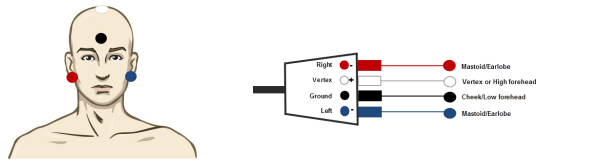
It is possible to obtain ALR with a standard 2-channel electrode montage, with an active vertex electrode referenced to either right or left mastoid. However, since the ALR has generators orientated towards the frontocentral regions of the scalp then response strength may be greater when recorded from a point on the midline that is slightly forward of the vertex position.
The Eclipse comes with a pre-programmed protocol for ALR testing (license), and is ready for immediate use. Protocols can be created or modified easily to fit your clinic needs. Consult your Eclipse Additional Information to learn how to create or modify a protocol.
Contact your local distributor
Our world-wide experts are ready to help you find the right solution.